
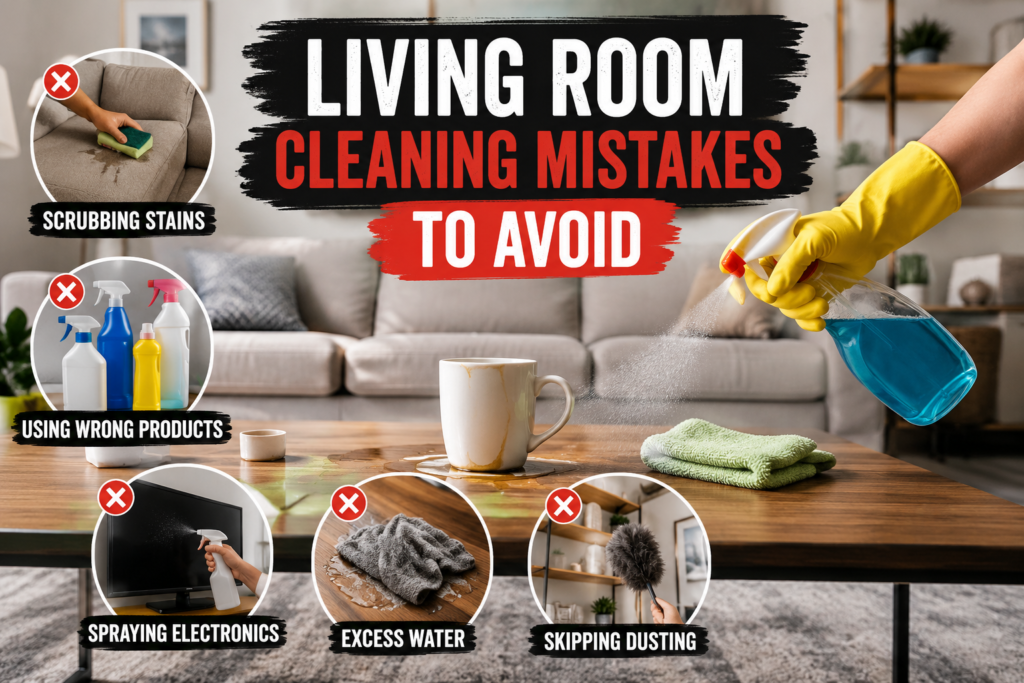
Living room cleaning mistakes can damage furniture, spread dirt and make cleaning harder than it needs to be. Knowing what to avoid helps you clean safely and effectively.
The living room contains a mixture of surfaces and materials, from fabric sofas and wooden furniture to electronics, carpets, rugs and painted finishes. A cleaning method that works perfectly on one may cause staining, discolouration or other damage to another.
Fortunately, most problems are easy to prevent. By using suitable products, cleaning in the right order and treating delicate materials carefully, you can keep your living room looking clean without creating unnecessary work or risking damage.
The Most Important Rule: Match the Cleaning Method to the Surface
Before using any cleaning product in your living room, check what you are actually cleaning. Avoid assuming that a general-purpose cleaner is suitable for every surface.
Wood, laminate, glass, natural stone, painted furniture, upholstery and electronic screens can all have different care requirements. When you are unsure, check the manufacturer’s care instructions and test unfamiliar products on a small, inconspicuous area first.
A safe approach is to:
- Remove loose dust before applying moisture.
- Use clean, soft cloths appropriate for the surface.
- Apply only as much product or water as necessary.
- Avoid mixing cleaning chemicals.
- Keep liquids away from electrical equipment.
- Allow upholstery and carpets to dry properly after wet cleaning.
If you want a complete routine rather than focusing only on mistakes, follow our step-by-step guide to cleaning a living room properly.
Common Living Room Cleaning Mistakes and What to Do Instead
Cleaning mistakes are not always obvious. Some simply leave the room looking less clean, while others can gradually damage furniture, fabrics or finishes.
1. Using the Same Cleaner on Every Surface
Reaching for one spray bottle for the entire living room may seem convenient, but different surfaces have different cleaning requirements.
A product suitable for glass may not be appropriate for finished wood, while a strong household cleaner could affect painted, polished or delicate surfaces.
Instead, identify the material before choosing a product. Follow the product label and the manufacturer’s care guidance where available. If you are trying something new, test it somewhere discreet first.
2. Spraying Cleaning Products Directly onto Electronics
Televisions, speakers, remote controls and other electronics require particular care around liquids.
Spraying cleaner directly onto a television or electronic device can allow moisture to reach openings, edges or internal components. Some screen coatings can also be damaged by unsuitable products.
Switch equipment off before cleaning where appropriate and follow the manufacturer’s cleaning instructions. For routine dusting, a clean, dry microfibre cloth may be sufficient. Never saturate the surface.
3. Soaking Fabric Sofas to Remove Marks
More water does not necessarily mean better stain removal.
Over-wetting upholstery can push moisture deeper into cushions and padding, increase drying time and sometimes leave water marks or encourage unpleasant smells. Different upholstery fabrics also respond differently to water and cleaning products.
Check the sofa’s care information before treating it. Blot spills rather than rubbing them aggressively, and use only a suitable amount of the recommended cleaning solution.
For more detailed upholstery care, see our guide to cleaning a fabric sofa properly.
4. Rubbing Spills and Stains Aggressively
When something is spilled, the natural reaction is often to scrub it immediately. That can make matters worse.
Hard rubbing may spread a liquid across a larger area, push it further into fibres or disturb the texture of upholstery and carpet.
Instead, deal with fresh spills promptly by gently blotting them with a clean, absorbent cloth. Work carefully rather than repeatedly scrubbing backwards and forwards.
Before using a stain remover, check that it is appropriate for the particular fabric or carpet and test it discreetly where necessary.
5. Cleaning Without Dusting or Vacuuming First
Applying a damp cloth to a dusty surface can turn loose dust into streaky residue. Similarly, attempting to wash or spot-clean a carpet without first removing loose debris can make the job unnecessarily difficult.
Start with dry cleaning methods.
Dust furniture, shelves, lamps and other surfaces, then vacuum upholstery, rugs and floors where appropriate. Once loose material has been removed, you can deal with marks and more stubborn dirt.
This top-to-bottom approach also reduces the chance of cleaning the floor and then covering it with dust from shelves and furniture.
6. Forgetting Hidden Dust Traps
A living room can look tidy while holding surprising amounts of dust in less visible places.
Commonly missed areas include:
- Behind and underneath furniture
- Skirting boards
- Lampshades
- Window sills
- Curtain edges
- Sofa crevices
- Under cushions
- Radiator surfaces
- Picture frames
- Around cables and television units
These areas do not necessarily need intensive attention every time you clean. Including a few of them in your regular routine prevents dirt from accumulating until a major clean becomes necessary.
A realistic living room cleaning schedule can help you separate everyday tasks from jobs that only need occasional attention.
7. Using Too Much Cleaning Product
Using extra product rarely makes a surface twice as clean.
Too much cleaner can leave sticky or streaky residue, particularly when the product is not removed or buffed as directed. Residue may also make some surfaces look dull and attract dirt more quickly.
Follow the product’s directions rather than estimating that a stronger concentration or larger amount will work better.
The same principle applies when cleaning upholstery and carpets: unnecessary moisture and product can make rinsing and drying more difficult.
8. Cleaning the Floor Too Early
Cleaning in the wrong order creates extra work.
If you vacuum or mop the floor first and then dust shelves, lamps, television units and furniture, some of that dust will inevitably fall onto your freshly cleaned floor.
Start higher in the room and work downwards. Deal with surfaces and furniture before finishing with rugs, carpets or hard flooring.
This simple change makes the whole routine more efficient.
Browse KeepShine’s free downloadable cleaning resources for practical ways to make regular household cleaning easier to organise.
Pro Tip

When dusting a living room, slightly reposition small objects rather than cleaning only around them. Dust often builds up along the edges of ornaments, lamps and electronics where a cloth normally stops. Periodically lifting movable items and cleaning underneath them gives a noticeably better result without turning every routine clean into a full deep clean.
How to Clean a Living Room Without Damaging Furniture and Fabrics
Preventing damage becomes particularly important when several materials are present in the same area. A wooden coffee table beside a fabric sofa and rug, for example, should not automatically be cleaned with the same product or technique.
Be Careful with Wood and Finished Furniture
Avoid leaving standing water on wooden furniture. Excess moisture can affect some finishes, joints and surfaces.
Use a method appropriate for the particular furniture and follow its care instructions. Do not assume that vinegar, disinfectant, furniture polish or another household product is suitable simply because it is commonly recommended online.
For unfamiliar products, a discreet patch test is sensible.
Treat Upholstery According to Its Material
Fabric sofas vary enormously. Some upholstery may tolerate particular water-based cleaning methods, while other fabrics require specialist treatment.
Check any care label or manufacturer’s instructions before applying a cleaner. Vacuuming with an appropriate attachment is often a useful starting point because it removes crumbs, hair and loose dirt without introducing moisture.
If your sofa needs considerably more attention than routine cleaning, it may be a good time to deep clean the rest of the living room at the same time.
Do Not Forget Drying Time
Anything cleaned using moisture needs enough time and ventilation to dry.
Avoid replacing cushions, throws or rugs while they are still noticeably damp. Where suitable, improve ventilation by opening windows and allowing air to circulate.
A good routine also reduces the need for frequent intensive cleaning. Our guide to keeping your living room clean for longer explains how small habits can help prevent dirt from building up between cleans.
Mistakes to Avoid
- Mixing cleaning products: Combining household cleaning chemicals can create dangerous reactions. Use products only as directed on their labels and never experiment with chemical mixtures.
- Using abrasive tools on delicate surfaces: Rough scourers and abrasive cleaners can scratch or dull certain furniture, glass and finished surfaces. Choose a tool that is suitable for the material you are cleaning.
- Ignoring care labels: Upholstery, rugs and removable covers may have specific cleaning restrictions. Checking the manufacturer’s instructions before wet cleaning can prevent avoidable shrinking, colour changes or other damage.
- Putting too much water on upholstery: Saturating a sofa does not necessarily remove a stain more effectively. Excess moisture can penetrate padding and dramatically increase drying time.
- Vacuuming carelessly around small objects and cables: Before vacuuming, move small items out of the way and check the area around electrical cables. Use suitable attachments for furniture, edges and delicate surfaces rather than forcing the main floor head into unsuitable spaces.
- Leaving spills until the next full clean: Fresh spills are often easier to manage than dried marks. Blot them promptly using a method appropriate for the material rather than waiting for your normal cleaning day.
If keeping on top of the whole living room is becoming difficult, KeepShine can provide professional home cleaning help when you would rather leave the cleaning to someone else.
More Questions About Safe Living Room Cleaning
Different furniture, fabrics and everyday situations can raise their own cleaning questions, so here are answers to a few useful ones.
How often should I deep clean my living room?
There is no single schedule suitable for every household. How quickly the room becomes dirty depends on factors such as the number of occupants, children, pets, how frequently the room is used and whether shoes are worn indoors.
Regular light cleaning usually prevents the room from reaching the point where everything needs intensive cleaning at once.
Can I use vinegar to clean everything in my living room?
No. Although vinegar is often suggested as a household cleaner, it is not suitable for every material or finish.
Do not treat any homemade cleaning solution as universally safe. Check the care requirements of the particular surface and, when necessary, use a product designed for that material.
Should I dust or vacuum the living room first?
Generally, deal with higher surfaces before finishing the floor. Dusting shelves, furniture and other raised areas first means anything that falls can be removed when you vacuum.
You can also vacuum upholstery and sofa crevices before completing the floor so that the final vacuum collects debris disturbed during the rest of the clean.
How can I stop my living room becoming dirty so quickly?
Small habits can make a considerable difference. Put items away after use, deal with spills promptly, avoid allowing clutter to accumulate and give high-use areas quick attention between larger cleans.
This makes routine cleaning faster and reduces how often you face a heavily cluttered or dusty room.
What if the whole house needs more than routine cleaning?
Rather than trying to complete every difficult job in one session, divide the work into rooms or manageable tasks. Start with areas that need attention most and work systematically.
Our thorough living room deep-cleaning guide can help when this particular room needs more than its normal routine.
Are living room cleaning principles useful in workplace seating areas?
Many principles are similar, particularly removing loose dust first, caring for upholstery correctly and keeping liquids away from electronics. However, workplace areas may experience heavier use and require a different cleaning routine.
For a related commercial space, see how to clean a meeting room properly or our wider guide to cleaning an office properly.
Subscribe to KeepShine for more practical cleaning guides, helpful household tips and useful resources for making everyday cleaning easier.
Final Thoughts: A Safer Routine Makes Living Room Cleaning Easier
Good living room cleaning is not about using the strongest product or scrubbing every surface as hard as possible. It is about understanding what you are cleaning and choosing a method that will remove dirt without unnecessarily risking the material underneath.
Start with loose dust and debris, work from higher areas towards the floor, use products only where they are suitable and take particular care with upholstery and electronics.
Once you establish a sensible routine, maintaining the room becomes much easier. A little regular attention can prevent many of the stains, dust build-ups and time-consuming cleaning jobs that otherwise develop later.