
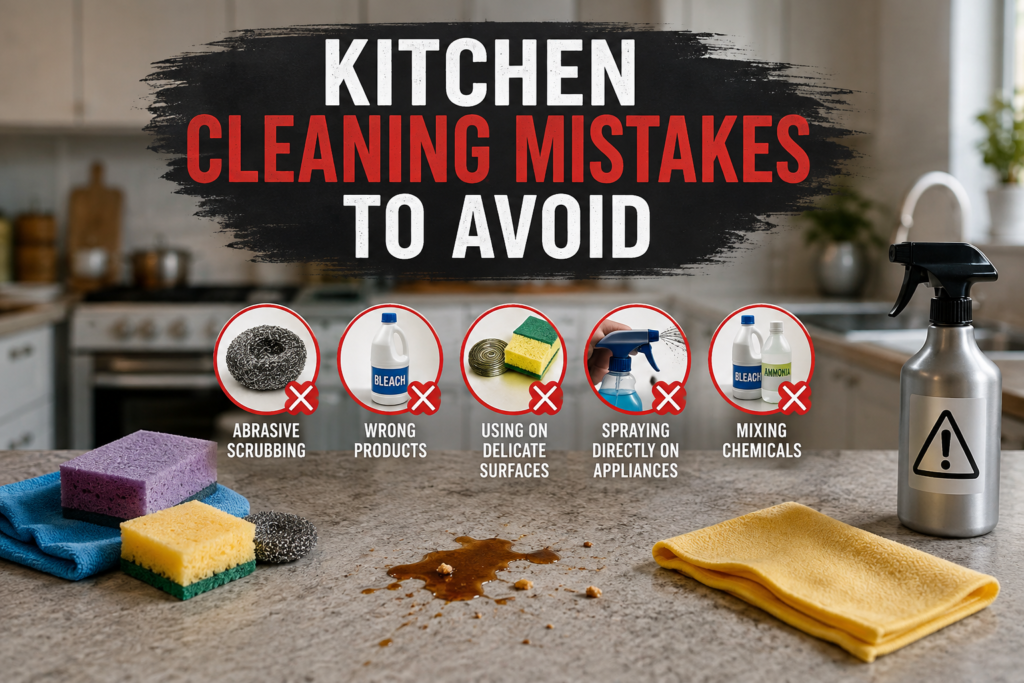
Kitchen cleaning mistakes can damage worktops, appliances and finishes or simply make cleaning harder than it needs to be. Knowing what not to use in your kitchen helps you clean effectively without causing unnecessary damage.
From mixing incompatible cleaning products to scrubbing delicate surfaces with abrasive tools, many common kitchen cleaning errors happen because a method that works well in one area is unsuitable for another. The safest approach is to match the cleaning method to the surface, appliance and type of dirt you are dealing with.
This guide explains the most important mistakes to avoid, what to do instead and how to keep your kitchen hygienic and well maintained without damaging its surfaces.
The Most Important Rule: Match the Cleaner to the Surface
Before using any cleaning product in your kitchen, check what the surface is made from and whether the product is suitable for it. A powerful cleaner is not automatically a better cleaner.
Natural stone, stainless steel, painted cupboards, laminate, wood, glass and appliance finishes can all react differently to cleaning products and scrubbing tools. Something perfectly suitable for ceramic tiles may damage a stone worktop or leave marks on stainless steel.
If you are unsure, check the manufacturer’s care instructions and test the product on a small, inconspicuous area first.
It is also worth remembering that more cleaning product does not necessarily produce a cleaner kitchen. Using the correct amount, allowing appropriate contact time where the product instructions specify one, and removing residues properly are usually more important than applying excessive quantities.
For a complete routine rather than focusing only on mistakes, our step-by-step guide to cleaning a kitchen properly explains how to work through the room efficiently.
Kitchen Cleaning Mistakes That Can Cause Damage or Poor Results
Most kitchen cleaning mistakes fall into three categories: using the wrong product, using the wrong technique or cleaning in an inefficient order. Avoiding the following errors can make everyday cleaning both safer and easier.
1. Using abrasive cleaners or scourers on delicate surfaces
Abrasive powders, rough scourers and hard scrubbing tools can be useful on certain durable surfaces, but they should not automatically be used everywhere.
Glossy cupboard doors, stainless-steel appliances, some sinks, coated surfaces, glass hobs and other delicate finishes may become scratched or dulled.
Use a soft microfibre cloth or another surface-appropriate cleaning tool unless the manufacturer recommends something different. When dealing with stubborn dirt, giving a suitable cleaner time to loosen the residue is often better than immediately reaching for a harsher scrubber.
2. Assuming vinegar is safe for everything
Vinegar is frequently recommended as a household cleaner, but its acidity means it is not suitable for every kitchen surface.
Acid-sensitive natural stone, including some marble and limestone surfaces, can be damaged or etched by acidic products. Certain appliance components, seals and specialist finishes may also have specific care requirements.
Do not assume that a cleaner is harmless simply because it is commonly described as “natural”. Check the care instructions for the material you are cleaning.
3. Mixing cleaning chemicals
Never mix household cleaning chemicals unless the product instructions explicitly say that they can be combined.
In particular, bleach should not be mixed with acids or ammonia-containing products because dangerous gases can be produced. Avoid experimenting with combinations of cleaning products in an attempt to make them stronger.
Use one appropriate product at a time, follow its label instructions and ventilate the kitchen when required.
4. Spraying cleaner directly onto electrical appliances
Spraying liquid directly onto controls, switches, seams, ventilation openings or other electrical components can allow moisture to enter places where it should not.
Instead, where appropriate, apply a small amount of suitable cleaner to a cloth and wipe the exterior. Appliances should be switched off or unplugged where the manufacturer’s cleaning instructions require it.
Never immerse electrical components in water, and always follow the appliance manufacturer’s guidance if you are unsure how a particular part should be cleaned.
5. Cleaning around crumbs instead of removing them first
Trying to wet-clean a worktop covered in crumbs, loose food and debris usually creates more work. The liquid turns loose dirt into a messy residue that then has to be moved around the surface.
Clear the worktop first, remove loose debris and then wipe or wash the surface.
The same principle applies to floors. Sweep or vacuum suitable flooring before mopping rather than attempting to mop over crumbs and grit.
6. Using one cloth throughout the entire kitchen
A single cloth can quickly transfer grease, crumbs and dirt from one area to another.
Use separate clean cloths for different tasks where practical, particularly when moving between food-preparation surfaces, sinks, bins and floors. Change or wash reusable cloths regularly rather than continuing to clean with one that has become visibly dirty.
This is especially important when following a larger thorough kitchen deep-cleaning routine, where many different surfaces are tackled during the same session.
7. Cleaning in an inefficient order
Starting with the floor and then cleaning cupboards, worktops and appliances above it often means cleaning the floor twice.
A more efficient approach is to work broadly from higher areas downwards. Clean upper cupboard fronts and other suitable higher surfaces before worktops and lower units, then finish with the floor.
Similarly, deal with dry debris before wet cleaning and give suitable products any label-directed contact time while you complete another task.
8. Forgetting to remove cleaning-product residue
Using too much cleaner can leave sticky or cloudy residue behind. That residue may attract dirt and make a supposedly clean surface look dull.
Follow the product’s directions carefully. If the instructions require rinsing, wipe the surface afterwards with clean water and then dry it where appropriate.
Food-preparation surfaces need particular care, so always follow the product label regarding suitability, rinsing and food-contact surfaces.
9. Treating every appliance in the same way
An oven, kettle, microwave, refrigerator and hob do not necessarily require the same products or methods.
Before cleaning an appliance thoroughly, check its care instructions. Removable parts may have different requirements from the main appliance, and some components should never be soaked.
Ovens are particularly easy to damage through unsuitable products or cleaning methods. Our guide to cleaning an oven properly covers the process in more detail.
10. Leaving spills until they become harder to remove
Not every kitchen mark needs to trigger a full cleaning session. However, dealing with spills reasonably quickly can prevent them drying, becoming sticky or spreading further.
Blot or wipe fresh spills using a method suitable for the affected material rather than allowing layers of residue to build up.
Small amounts of regular maintenance can also reduce the effort needed later. Our guide to keeping your kitchen clean for longer explains how simple everyday habits can help.
Explore KeepShine’s free downloadable cleaning resources for practical ways to make household cleaning and organisation easier.
Pro Tip

When trying a new cleaning product, do not start with the most visible part of a worktop, cupboard or appliance. Test it on a small hidden area first and allow the surface to dry fully before deciding whether it is suitable; some discolouration, dulling or residue becomes easier to see only after drying.
What Not to Use on Common Kitchen Surfaces
The safest cleaning method depends heavily on the material. Rather than having one “all-purpose” technique for everything, adapt your approach to the surface in front of you.
Natural stone worktops
Avoid assuming acidic household products such as vinegar or lemon juice are suitable for natural stone. Some stone can etch or become damaged when exposed to acids.
Use products recommended for the particular stone and follow any sealing and maintenance guidance supplied by the manufacturer or installer.
Stainless steel
Avoid harsh abrasives unless the manufacturer specifically permits them. Scrubbing aggressively can affect the appearance of the finish.
Use a soft cloth and a suitable cleaner, and wipe in the direction of the visible grain where applicable. Drying afterwards can also help reduce water marks.
Wooden surfaces
Excessive water is generally a poor choice for wooden kitchen surfaces. Water left standing on wood can potentially affect the finish or penetrate joints and damaged areas.
Use a lightly damp cloth and a product appropriate for the particular finish, then remove excess moisture promptly.
Glass and ceramic hobs
Do not automatically use a metal scraper, abrasive pad or harsh cleaner on a hob. Different hob surfaces have different care requirements, and unsuitable tools can scratch them.
Allow the hob to cool as directed by its manufacturer before cleaning and use the recommended method for your model.
Painted and high-gloss cupboards
Strong chemicals and abrasive tools may damage, discolour or dull some cupboard finishes. Begin with the gentlest suitable method and avoid soaking doors, particularly around joins and edges.
If you are unsure about a specialist finish, consult the kitchen manufacturer’s care guidance before using a new product.
A more thorough clean does not have to mean harsher chemicals or harder scrubbing. Good technique, suitable products and regular maintenance are usually far more important.
Mistakes to Avoid
- Using more product than necessary. Extra cleaner does not automatically improve results. It can leave residue that requires additional wiping and may make surfaces look streaky or sticky. Follow the quantity and dilution instructions on the label.
- Using the same cleaner everywhere. Kitchens contain many different materials, and a product suitable for one may be unsuitable for another. Check compatibility before moving from worktops to cupboards, appliances or flooring.
- Mixing products to make a “stronger” cleaner. Combining household chemicals can create dangerous reactions. Never mix cleaning products unless their instructions explicitly permit it.
- Scrubbing before giving dirt time to soften. Aggressive scrubbing can damage finishes unnecessarily. When appropriate, apply a suitable cleaner according to its instructions and allow the recommended contact time before wiping.
- Ignoring hidden areas. Handles, cupboard edges, splashback corners and the spaces around frequently used appliances can gradually accumulate grease and dirt. Include these areas in periodic deeper cleaning rather than concentrating only on obvious worktops and floors.
If keeping on top of a busy kitchen is becoming difficult, KeepShine can provide professional home cleaning help as part of a cleaning service suited to your needs.
Common Questions About Safe Kitchen Cleaning
Even with a good routine, it is easy to be unsure about particular products, surfaces and cleaning methods. Here are answers to some common questions about avoiding kitchen cleaning errors.
Can I use washing-up liquid to clean kitchen surfaces?
A small amount of washing-up liquid diluted appropriately can be useful on some washable surfaces, particularly for removing grease, but it is not suitable for everything.
Check the surface manufacturer’s instructions, avoid excessive water and remove soapy residue where necessary. Specialist materials such as natural stone or certain treated finishes may require products designed specifically for them.
Is bleach necessary for cleaning a kitchen?
Not necessarily. Routine removal of grease, crumbs and general dirt can often be carried out with an appropriate cleaning product without bleach.
If you use a disinfectant or bleach-based product for a particular purpose, make sure it is suitable for the surface and follow its label instructions carefully. Never mix bleach with other cleaning chemicals.
How often should I deep clean my kitchen?
There is no single schedule that suits every household. Cooking frequency, household size, pets and how heavily the kitchen is used all affect how quickly dirt and grease accumulate.
Routine cleaning should deal with everyday mess, while periodic deeper cleaning can cover areas that are not addressed every day. Our practical kitchen cleaning schedule can help you decide what needs attention and when.
Why does my kitchen still look dirty after I clean it?
Dirty cloths, too much cleaning product, missed grease, streaks and cleaning surfaces before removing loose debris can all affect the finished result.
Try using clean cloths, appropriate quantities of product and a systematic top-to-bottom routine. Also inspect often-missed areas such as handles, splashbacks, cupboard edges and the fronts of frequently used appliances.
Should I disinfect every kitchen surface every day?
Cleaning and disinfecting are different tasks, and not every surface necessarily requires routine disinfection.
Focus first on removing visible dirt and food residue. Where disinfection is appropriate, choose a product intended for the surface and follow its directions, including any required contact time or rinsing instructions. Pay particular attention to manufacturer guidance for food-contact surfaces.
Are the same mistakes important in an office kitchen?
Many of the same principles apply, including avoiding chemical mixing, preventing cross-contamination and using suitable products on appliances and surfaces. However, shared kitchens can require more structured routines because many people use them.
For a workplace setting, see our step-by-step office kitchen cleaning guide.
Subscribe to KeepShine for more practical cleaning guides, safer cleaning advice and useful resources to make looking after your home easier.
Final Thoughts: Clean Carefully Rather Than Cleaning More Aggressively
Avoiding kitchen cleaning mistakes is largely about choosing the right method rather than using stronger products or applying more force.
Before cleaning an unfamiliar surface, identify the material, check its care instructions and choose an appropriate product and tool. Keep cleaning chemicals separate, use electrical appliances carefully and remember that gentle methods can often produce excellent results when used correctly.
A simple routine also makes a difference. Deal with spills before they become stubborn, keep cloths and cleaning tools clean, and tackle deeper jobs periodically rather than waiting for heavy dirt to accumulate.
The goal is not simply a kitchen that looks clean today, but one that can be cleaned effectively while protecting its surfaces, appliances and finishes for the future.