
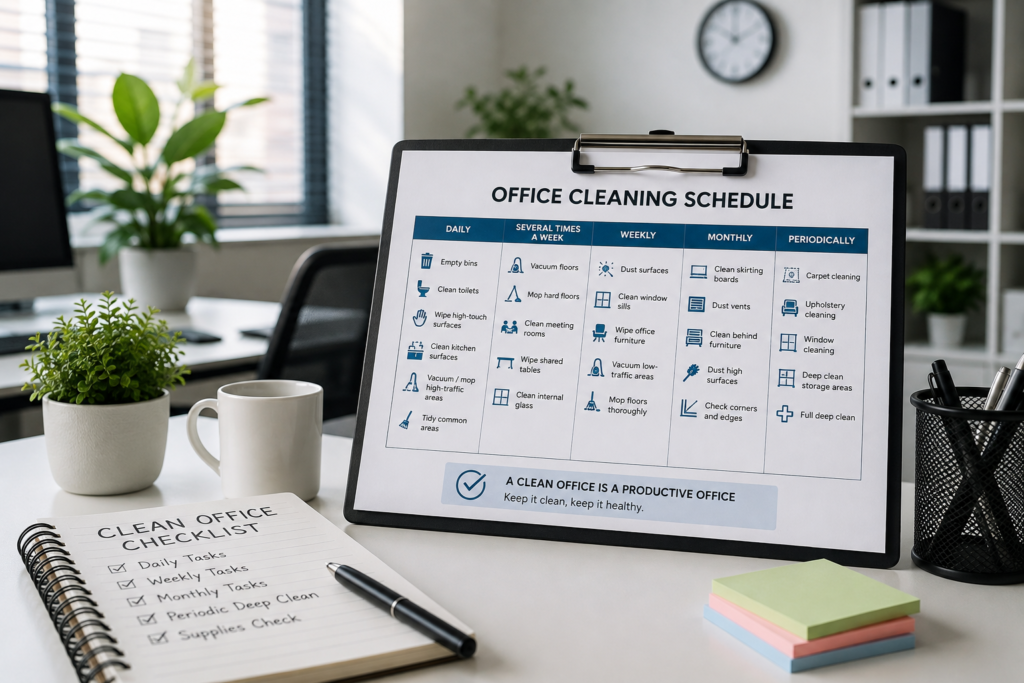
Keeping an office clean is easier when you follow a sensible office cleaning schedule rather than waiting until dirt becomes obvious. Different areas need cleaning at different intervals, from daily touchpoint cleaning to periodic deep cleaning.
How often you should clean an office depends on how many people use the space, the type of work carried out, whether customers visit and which areas receive the most traffic. A small office with a handful of employees will usually need a different routine from a busy workplace with shared kitchens, toilets and meeting rooms.
The key is to match cleaning frequency to how quickly each area becomes dirty. This guide explains what should normally be cleaned daily, weekly, monthly and periodically, along with the signs that your workplace may need cleaning more frequently.
A Practical Office Cleaning Schedule at a Glance
For most workplaces, frequently touched surfaces, kitchens, toilets and obvious spills should receive attention every working day. General dusting, detailed desk-area cleaning and less frequently touched surfaces can usually be handled weekly, while deeper tasks can be scheduled monthly or periodically.
A practical starting point is:
- Daily: bins, toilets, kitchen areas, high-touch surfaces, visible dirt and busy floors.
- Several times a week: vacuuming or mopping depending on foot traffic, meeting rooms and shared workspaces.
- Weekly: general dusting, detailed floor cleaning, less-used areas and accessible office furniture.
- Monthly: skirting boards, vents, higher surfaces and areas that are easily overlooked.
- Periodically: carpets, upholstery, windows and a more comprehensive deep clean.
This isn’t a rigid rule. Your schedule should change according to how the office is actually used.
What to Clean Daily, Weekly, Monthly and Periodically
Instead of treating the entire workplace as one cleaning job, divide it into areas and tasks. This makes it easier to decide when to clean an office and prevents important jobs from being forgotten.
If you are establishing a new routine, our step-by-step guide to cleaning an office properly can help you decide how individual cleaning tasks should be carried out.
Daily office cleaning tasks
Daily cleaning should concentrate on hygiene, waste, spills and the areas employees and visitors use most frequently.
Typical daily tasks include:
- Emptying general waste bins where necessary.
- Cleaning toilets and replenishing soap, toilet paper and other supplies.
- Cleaning kitchen worktops, sinks and frequently used surfaces.
- Wiping shared high-touch points such as door handles and switches as appropriate.
- Cleaning spills and visible marks promptly.
- Vacuuming or mopping high-traffic areas where needed.
- Tidying reception and customer-facing areas.
- Removing food waste before it begins to smell or attract pests.
Office kitchens deserve particular attention because food preparation, shared appliances and frequent handling can quickly leave surfaces dirty.
You don’t necessarily need to clean every individual desk thoroughly every day. Employees can help by removing cups, food packaging and unnecessary clutter so that scheduled cleaning can be completed efficiently.
For detailed desk cleaning, follow our guide to cleaning an office desk properly, particularly when dealing with keyboards, monitors and other equipment that requires appropriate care.
Tasks to complete several times a week
Some cleaning jobs fall between daily and weekly cleaning.
Floors are a good example. A quiet upstairs office might not require complete vacuuming every day, while a busy reception area could need attention daily or even during the working day in poor weather.
Several-times-a-week tasks may include:
- Vacuuming general office areas.
- Mopping suitable hard floors.
- Cleaning meeting rooms after frequent use.
- Wiping shared tables and workstations.
- Cleaning internal glass where fingerprints are noticeable.
- Checking communal areas for accumulated dirt.
Use the condition of the workplace rather than the calendar alone. If something is visibly dirty, don’t leave it simply because its scheduled cleaning day hasn’t arrived.
Weekly office cleaning tasks
Weekly cleaning allows you to deal with areas that don’t normally become unhygienic or noticeably dirty after a single day’s use.
Depending on your workplace, this could include:
- Dusting accessible shelves and furniture.
- Cleaning window sills.
- Cleaning less frequently touched surfaces.
- Wiping appropriate office furniture.
- Vacuuming lower-traffic areas thoroughly.
- Mopping suitable hard floors thoroughly.
- Cleaning around and underneath movable items where practical.
- Removing marks from doors and other surfaces where safe to do so.
Weekly cleaning is also a useful opportunity to look for areas that have gradually been missed.
Small amounts of dust along an edge or beneath furniture may not seem significant each day, but over several weeks they can make the workplace look poorly maintained.
Monthly office cleaning tasks
Monthly cleaning should concentrate on details that aren’t normally included in routine daily cleaning.
Examples include:
- Dusting accessible vents where appropriate.
- Cleaning skirting boards.
- Cleaning behind easily movable furniture.
- Dusting higher accessible surfaces safely.
- Checking corners and edges for accumulated dirt.
- Cleaning less frequently used storage or communal spaces.
- Inspecting upholstery for marks or stains.
- Cleaning accessible door frames and other overlooked surfaces.
This is also a good time to review the cleaning schedule itself. If particular areas are consistently dirty before their next scheduled clean, increase their frequency.
Periodic deep cleaning
Routine cleaning controls everyday dirt, but it doesn’t replace deeper cleaning.
Depending on the premises and how heavily they are used, periodic work might include carpet cleaning, upholstery cleaning, detailed floor care, window cleaning and a thorough clean of areas that aren’t normally included in everyday routines.
Rather than assuming every workplace needs deep cleaning at exactly the same interval, inspect its condition.
A busy office may benefit from deeper cleaning more frequently than a lightly occupied workplace. If you are planning one, our thorough office deep-cleaning guide explains how this differs from ordinary routine cleaning.
Browse KeepShine’s free downloadable cleaning resources for practical ways to make regular cleaning and organisation easier.
Pro Tip
Instead of giving every office area the same cleaning frequency, identify your highest-traffic and highest-touch zones first. Entrances, kitchens, toilets and shared spaces often need considerably more attention than storage rooms or lightly used offices, so concentrating resources where dirt accumulates fastest can make the overall cleaning schedule much more effective.
Adjust Your Cleaning Frequency to Your Workplace
A cleaning schedule works best when it reflects the actual workplace rather than following a generic timetable.
Number of employees
An office used by five people will generally accumulate waste, dust and kitchen mess more slowly than one occupied by 50 people.
As staff numbers increase, shared facilities receive more use. Toilets, kitchens, bins, entrances and meeting rooms may therefore need more frequent attention.
Visitors and customers
Customer-facing workplaces usually need particular attention around entrances, reception areas and meeting spaces.
These areas influence the impression visitors receive when they enter the premises. A reception floor that becomes dirty during wet weather, for example, shouldn’t wait until the next scheduled weekly clean.
Type of workplace
Not every office operates in the same environment.
An administrative office may have relatively predictable cleaning requirements. An office connected to a warehouse, workshop or industrial environment may experience more dirt being brought into staff areas on footwear and clothing.
Your cleaning plan should therefore reflect what actually happens within the premises.
Seasonal conditions
Cleaning requirements can change throughout the year.
Rain and muddy conditions can increase floor cleaning around entrances. During other periods, open windows and increased airborne dust may affect how frequently certain surfaces need attention.
The most useful schedule is therefore one that can be adjusted rather than followed rigidly throughout the year.
Good everyday habits also reduce unnecessary cleaning. Our guide to keeping an office clean for longer covers practical ways employees can help maintain the workplace between scheduled cleans.
Mistakes to Avoid
-
- Using one frequency for the entire office. Toilets, kitchens and entrances generally need more frequent attention than low-use storage spaces. Prioritise cleaning according to use, hygiene needs and visible dirt.
- Waiting until dirt becomes obvious. A workplace shouldn’t have to look dirty before cleaning begins. Regular maintenance helps prevent waste, dust and grime from building up into a larger job.
- Ignoring high-touch shared surfaces. Door handles, shared tables and other frequently handled surfaces can easily be overlooked when cleaning focuses mainly on floors and bins. Include appropriate touchpoint cleaning in the routine.
- Cleaning electrical equipment incorrectly. Don’t spray cleaning products directly onto computers, monitors, sockets or other electrical equipment. Follow the equipment manufacturer’s cleaning and safety instructions where appropriate.
- Never reviewing the schedule. A timetable that worked when an office had ten employees may be inadequate after the workforce grows. Review the routine when occupancy, working patterns or premises change.
For more examples of habits that can undermine an otherwise good routine, see our guide to common office cleaning mistakes to avoid.
If keeping up with your office cleaning schedule is becoming difficult, KeepShine can provide professional cleaning support tailored to your workplace.
More Questions About Office Cleaning Frequency
Cleaning needs vary between workplaces, so these answers cover a few additional questions that can help you refine your routine.
Does an office need to be cleaned every day?
Not necessarily every part of it. Busy toilets, kitchens, bins, entrances and shared touchpoints may need daily attention, while some lower-use areas can be cleaned less frequently. The best approach is to divide the office into tasks and areas rather than assuming everything needs exactly the same frequency.
How often should office floors be cleaned?
It depends heavily on foot traffic and flooring type. Busy entrances may require daily cleaning, particularly during wet weather, while quieter carpeted areas might need vacuuming several times a week. Spills should be dealt with promptly using a method suitable for the flooring material.
How often should office desks be cleaned?
Shared desks may require more frequent cleaning than individually assigned desks. For personal workstations, regular weekly cleaning may be suitable alongside day-to-day tidying, depending on use. Always take appropriate care around electronics and check manufacturer guidance before using cleaning products on sensitive equipment.
How often should an office have a deep clean?
There is no single interval suitable for every business. Consider foot traffic, occupancy, flooring, furniture and how quickly less-accessible areas accumulate dirt. Regular inspections are more useful than choosing an arbitrary date. Our office deep-cleaning guide can help when a more thorough clean is required.
Should the cleaning schedule change when more staff join?
Yes. Increased occupancy usually means greater use of toilets, kitchens, bins, meeting rooms and shared spaces. If your workforce grows significantly, review the schedule rather than simply expecting the existing cleaning routine to cope with the additional use.
How can you tell if the office isn't being cleaned often enough?
Repeated overflowing bins, dusty surfaces, marked floors, unpleasant smells or toilets and kitchen areas becoming dirty before the next clean are useful warning signs. Rather than simply cleaning harder, identify which areas are repeatedly affected and increase their cleaning frequency.
Subscribe to KeepShine for more practical office cleaning guides, useful cleaning tips and resources to help you maintain a cleaner workplace.
Final Thoughts: Build a Schedule Around How Your Office Is Used
The most effective answer to how frequently to clean an office isn’t a single number. It is a routine based on how quickly different parts of your workplace become dirty.
Start with daily attention for hygiene-critical and heavily used areas, then schedule weekly, monthly and periodic tasks for areas that accumulate dirt more slowly. Review the routine whenever staffing levels, working patterns or the premises change.
Most importantly, treat the schedule as a practical guide rather than a reason to postpone cleaning. If a spill occurs, a bin is full or an entrance becomes muddy, deal with it when it needs attention. That simple approach helps keep the workplace consistently presentable instead of alternating between clean and visibly overdue for attention.