
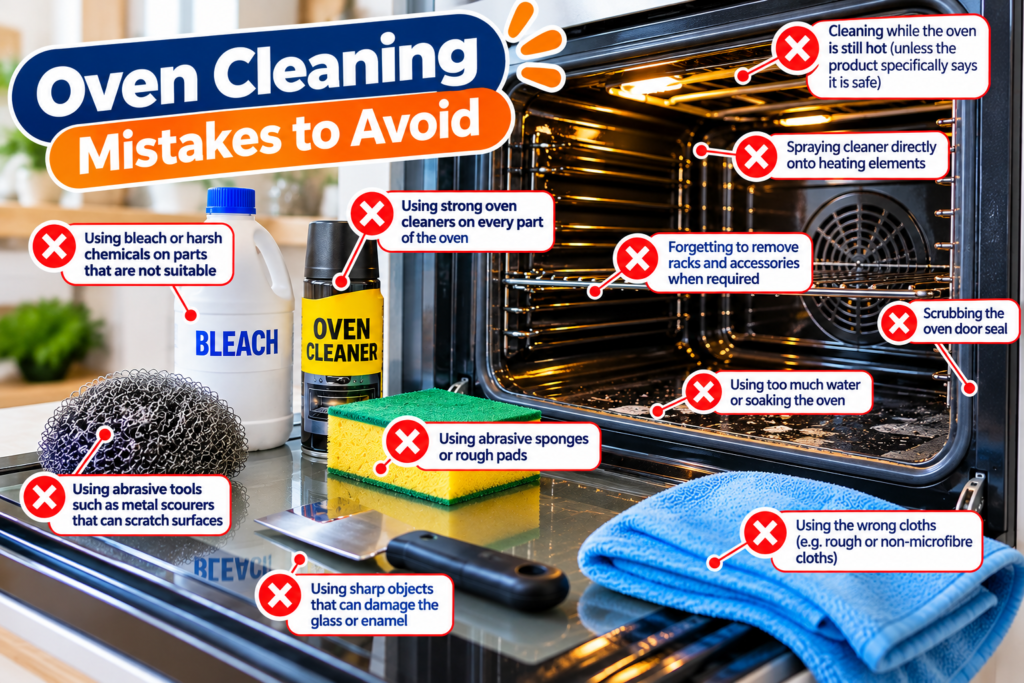
Oven cleaning mistakes can damage surfaces, leave chemical residue or make a dirty oven harder to clean. Knowing what not to use on an oven matters just as much as knowing how to clean it.
Grease, burnt food and baked-on spills can tempt you to reach for the strongest cleaner or scrubber available. Unfortunately, some aggressive methods can scratch coatings, damage seals or leave products where they should not be.
A safer approach starts with identifying which parts of your oven can be cleaned, choosing suitable products and allowing enough time for stubborn dirt to soften. If you need the full cleaning process rather than the common errors covered here, our step-by-step oven cleaning guide explains the routine from start to finish.
What to Know Before You Start Cleaning Your Oven
Before using any cleaning product, check the manufacturer’s care instructions for your particular oven. Ovens contain different materials, coatings, heating systems and removable parts, so a method that is suitable for one model may not be appropriate for another.
Allow the oven to cool completely unless its manufacturer specifically instructs otherwise. Switch it off before manually cleaning the interior, remove loose crumbs and debris, and make sure the room is adequately ventilated when using cleaning products.
Most importantly, do not assume that stronger chemicals or harder scrubbing will produce better results. For baked-on grease, giving an appropriate cleaner enough contact time is usually more sensible than attacking the surface with excessive force.
If your oven has accumulated substantial grease and burnt residue, a thorough oven deep clean may be more appropriate than repeatedly spot-cleaning individual areas.
The Oven Cleaning Mistakes Most Likely to Cause Problems
Avoiding damage is largely about using the right method for the right part of the appliance. These are some of the most important errors to watch for.
1. Using abrasive tools on coated surfaces
Wire wool, metal scourers and other highly abrasive tools can appear ideal for stubborn burnt-on food. The problem is that they may scratch enamel, glass or other finished surfaces.
Once a surface has been scratched, cleaning it more aggressively will not reverse the damage.
Instead, loosen stubborn residue before trying to remove it. Use tools and cleaning products suitable for the particular surface, following the oven manufacturer’s instructions. A soft cloth, non-scratch sponge or other manufacturer-approved tool is generally a safer starting point than an aggressive scourer.
2. Assuming every oven cleaner is suitable for every part
Commercial oven cleaners can be effective, but that does not mean they belong on every component inside an oven.
Different products have different restrictions, while oven manufacturers may warn against applying cleaners to particular coatings, heating elements, fans, seals or other components.
Read both sets of instructions: the product label and your appliance’s care guidance. If either says that a product should not be used on a particular material or component, choose another suitable method.
Never mix different cleaning chemicals in an attempt to make them stronger.
3. Spraying cleaner directly onto heating elements
Heating elements are not ordinary wipe-clean surfaces. Avoid deliberately coating them with oven cleaner, degreaser or large quantities of water unless the manufacturer specifically states that this is appropriate for your appliance.
The same caution applies around electrical components, vents and other areas where liquid should not be allowed to collect.
Apply cleaning products carefully and control where they go. Spraying indiscriminately around the entire oven cavity can put cleaner into places where you did not intend it to reach.
4. Scrubbing the oven door seal
The seal around an oven door plays an important role in helping the door close correctly. Vigorous scrubbing, pulling or saturating it with cleaning chemicals can potentially damage it.
Treat the seal gently and follow the manufacturer’s instructions for cleaning it. If it is loose, split or visibly deteriorating, cleaning will not repair it.
The surrounding frame can collect crumbs and grease, but remove these carefully rather than using the seal itself as a surface to scrub against.
5. Using too much water
An oven may look like a large enclosed metal box, but it is still an electrical appliance.
Pouring water into the oven cavity or soaking components unnecessarily can allow moisture to reach places that are difficult to dry. A dripping cloth also gives you much less control than a properly wrung-out one.
Use only as much moisture as the cleaning method requires. When wiping away cleaner, rinse your cloth regularly rather than flooding the surface.
This is particularly important around openings, electrical components and areas identified by the manufacturer as unsuitable for wet cleaning.
6. Cleaning a hot oven without instructions to do so
A warm surface can sometimes soften grease, but deliberately applying products to a hot oven can be unsafe if the product is not designed for that use. Heat may also cause some cleaners to dry too quickly or behave differently from intended.
Do not improvise.
Allow the appliance to cool and follow the temperature instructions supplied with both the oven and cleaning product. If a method specifically requires warmth, use only the conditions recommended for that method.
7. Using the self-cleaning function without checking first
If your oven has a self-cleaning programme, do not assume that you can simply switch it on regardless of what is inside.
Racks, trays, liners and accessories may have different care requirements, and heavy loose debris or spills may need attention beforehand. Procedures also vary between models.
Read the manufacturer’s instructions before running any self-cleaning cycle, including guidance about ventilation, removable components and preparation.
If you are unsure whether your oven has a self-cleaning feature or how it operates, check the appliance manual rather than experimenting with the controls.
Browse KeepShine’s free downloadable cleaning resources for practical help with making household cleaning easier to organise.
Pro Tip

For stubborn baked-on residue, patience can protect your oven better than extra scrubbing pressure. Give a suitable cleaning method the recommended time to soften the deposit, then remove it gradually with a surface-safe tool. Several gentle passes are often preferable to trying to remove everything at once with an abrasive scourer.
Why Different Parts of Your Oven Need Different Treatment
One reason oven cleaning errors happen is that the appliance is treated as though every visible surface is made from the same material. It is not.
Oven glass
The inside of the door can accumulate brown grease and baked-on splashes. Avoid assuming that a blade, harsh abrasive or strong chemical is automatically safe simply because the glass looks tough.
Some oven doors have coated or treated glass. Follow the manufacturer’s recommendations and use suitable non-scratch cleaning tools.
Racks and trays
Removable racks may tolerate cleaning methods that would be inappropriate inside the oven cavity, but their finishes can vary. Check their care instructions before soaking them for long periods or applying abrasive products.
If you regularly clean the hob as well as the oven, our guide to cleaning a hob properly covers another kitchen surface where material-specific care matters.
Enamel and catalytic liners
Not every oven interior should be scrubbed in the same way. Some appliances contain special liners or coatings designed to deal with grease differently from conventional enamel.
Aggressive cleaning may interfere with specialised surfaces. Always identify what your oven contains before choosing a method.
Knobs, controls and exterior surfaces
Cleaning products should not be allowed to run into control panels or electrical openings. Apply an appropriate product to a cloth where suitable rather than spraying excessively around controls.
The same principle applies throughout the room: different surfaces need different methods. Our complete kitchen cleaning guide can help you organise the rest of the kitchen without treating every area identically.
Regular light cleaning also reduces the need for aggressive methods later. A sensible oven cleaning schedule can help prevent grease and spills from becoming heavily baked on.
Mistakes to Avoid
- Leaving loose food at the bottom of the oven. Crumbs, drips and food deposits can continue to burn during cooking. Once the oven is cool, remove loose debris rather than allowing it to accumulate.
- Ignoring spills until the next deep clean. A fresh spill may become much harder to remove after repeated heating. Deal with suitable spills once the appliance has cooled rather than waiting until months of residue have accumulated.
- Forgetting to remove cleaning residue. Where a cleaning product requires wiping or rinsing away, follow its instructions carefully. Do not assume that visible grease disappearing means the cleaning process is finished.
- Rushing stubborn areas. Repeated hard scrubbing can damage a surface while achieving little. Allow an appropriate cleaning method time to work before applying more pressure.
- Using improvised oven liners incorrectly. Do not place foil, mats or other materials inside the oven unless their use and positioning are permitted by your oven manufacturer. Follow appliance guidance rather than using a liner simply because it seems easier to clean.
For more ways to reduce future build-up, see our tips for keeping your oven cleaner for longer.
If tackling a heavily soiled oven feels like more work than you want to take on, KeepShine can provide professional cleaning help as part of your home cleaning service.
More Questions About Safe Oven Cleaning
Oven materials and cleaning methods vary, so these answers cover a few additional questions that commonly arise when trying to clean an oven without damage.
Can I use washing-up liquid to clean an oven?
A small amount of washing-up liquid diluted appropriately may be useful for some removable or wipeable surfaces, but suitability depends on the material and appliance guidance. Avoid assuming it is appropriate everywhere inside the oven. Check the manufacturer’s instructions, use minimal moisture and remove any cleaning residue as required.
Can I use bicarbonate of soda inside my oven?
Bicarbonate of soda is often discussed as a household cleaning option, but a familiar ingredient is not automatically suitable for every oven surface. Special coatings and liners may have specific restrictions. Check your manufacturer’s care guidance before applying homemade cleaning mixtures to the oven interior.
Is it safe to use vinegar when cleaning an oven?
That depends on where and how it is being used. Acidic cleaners are not suitable for every material or finish, so avoid treating vinegar as a universal oven cleaner. Check the care instructions for your appliance and use a product or method that is compatible with the surface being cleaned.
How often should I deep clean my oven?
There is no single schedule that suits every household. An oven used daily for roasting and baking may need attention sooner than one used occasionally. Rather than relying only on a fixed date, monitor grease, burnt deposits and spills and clean them before they become excessive.
For a more practical routine, use our guide to how often an oven should be cleaned.
What should I do if burnt food will not come off?
Avoid immediately switching to a metal scourer or stronger chemical. First confirm what the surface is made from, then use a compatible method to soften the deposit. Work gradually and repeat the process if necessary.
If the whole appliance has reached this stage, follow a structured deep-cleaning process for your oven rather than repeatedly attacking isolated patches.
Should I clean the oven before or after cleaning the rest of the kitchen?
For a full kitchen clean, it usually makes sense to plan tasks so that crumbs, grease or cleaning drips created during one job do not dirty an area you have already finished. The exact order depends on what you are cleaning, but working systematically saves unnecessary repetition.
Subscribe to KeepShine for more practical cleaning guides, safer cleaning tips and useful resources for looking after your home.
Final Thoughts: Gentle Cleaning Is Often the Safer Approach
Cleaning an oven effectively does not require using the strongest chemical or the roughest tool you can find. The important part is matching the cleaning method to the surface, controlling moisture and giving stubborn residue enough time to loosen.
Check your oven’s care instructions before trying an unfamiliar product or technique, particularly around specialised liners, seals, heating elements and electrical components.
Once the oven is clean, deal with manageable spills and loose debris regularly. That simple habit can prevent the heavy build-up that makes aggressive cleaning methods tempting in the first place.