
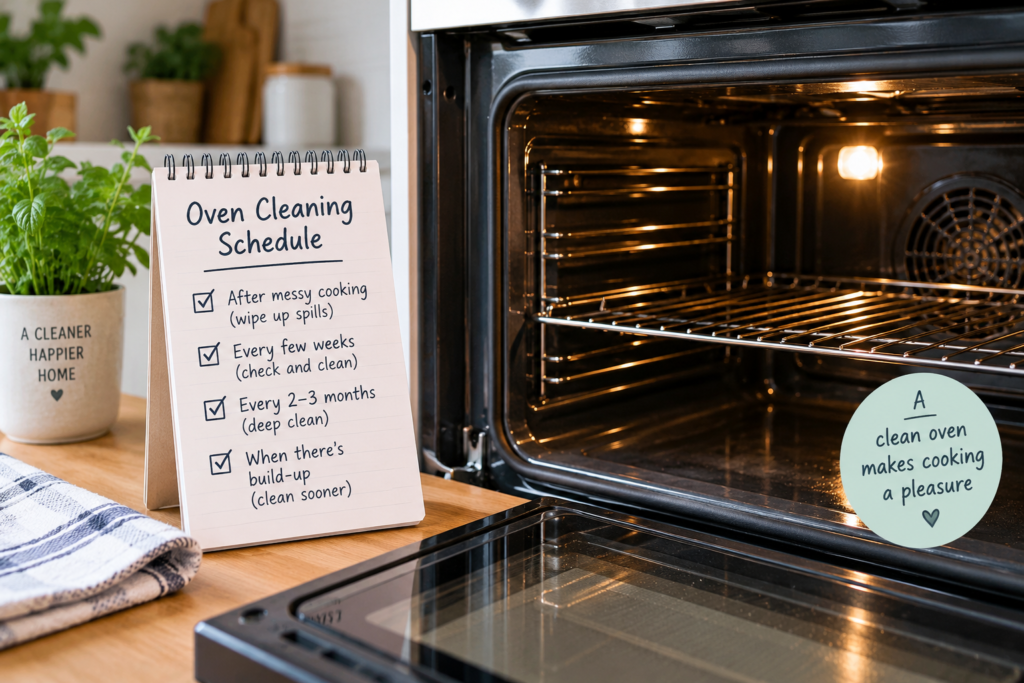
If you are wondering how often to clean your oven, a good general rule is to deal with fresh spills promptly, clean it routinely every few months, and deep clean it when grease and burnt-on food begin to build up.
How frequently your oven actually needs attention depends on how often you cook, what you cook and how messy those meals tend to be. An oven used every day for roasting and baking will usually need cleaning sooner than one used only occasionally.
Rather than waiting until the oven looks heavily soiled, a simple cleaning schedule can keep grease and food residue manageable and make each clean much easier.
A Practical Oven Cleaning Schedule
For most households, there is no need to thoroughly clean the entire oven every week. A combination of quick maintenance and occasional deeper cleaning is usually more practical.
A useful oven cleaning schedule is:
- After messy cooking: Wipe up spills and splashes once the oven has completely cooled.
- Every few weeks: Check the door, glass, racks and visible surfaces for grease or food residue and clean them when needed.
- Every 2–3 months: Give a regularly used oven a more thorough clean, adjusting the frequency according to how dirty it becomes.
- When there is significant build-up: Deep clean the oven rather than relying on another quick wipe.
These are practical guidelines rather than fixed rules. Your oven’s condition is a better guide than the calendar, particularly if your household cooks frequently.
How Often to Clean Each Part of Your Oven
Different areas become dirty at different rates, so you do not necessarily need to clean everything at once. Breaking the job into smaller tasks can make regular oven maintenance much easier.
Clean fresh spills as soon as practical
If food bubbles over or liquid spills inside the oven, deal with it reasonably soon rather than repeatedly heating the residue.
Wait until the oven is switched off and completely cool before cleaning. Removing a fresh spill is generally much easier than tackling the same residue after it has been baked onto the surface several times.
If you are unsure how to tackle the oven safely, our step-by-step guide to cleaning an oven properly explains the full process.
Never pour water or cleaning products onto hot oven surfaces. Sudden temperature changes can damage some materials, and working around a hot appliance creates an unnecessary risk of burns.
Check the oven interior every few weeks
You do not have to scrub the oven interior every few weeks. Instead, inspect it.
Look for grease splashes, crumbs, burnt food and residue on the base and sides. If there is only a small amount of dirt, spot cleaning may be enough.
This regular check helps prevent a minor mess from gradually becoming a difficult cleaning job.
For households that roast meat, cook uncovered dishes or use the oven almost every day, checking more frequently can be worthwhile.
Clean the oven racks when they become greasy
Oven racks do not necessarily need cleaning every time you clean the interior.
Inspect them for sticky grease, burnt food and accumulated residue. Light marks can often be wiped away, while heavier build-up may require removing and cleaning the racks separately.
Before soaking racks or using a particular cleaning product, check the manufacturer’s instructions. Rack coatings and materials vary, and some finishes may not be suitable for abrasive products or prolonged soaking.
Wipe the oven door regularly
The door can become greasy surprisingly quickly, particularly around the handle and edges where hands frequently touch it.
Wipe the exterior whenever you notice fingerprints, grease or food marks. The inner glass can be cleaned when splashes begin affecting its appearance or visibility.
Avoid assuming that the door can be dismantled for cleaning. Some oven doors have removable glass panels, while others require a particular procedure. Follow the manufacturer’s instructions before removing any components.
Give the oven a thorough clean every 2–3 months
For an oven used regularly, checking whether it needs a thorough clean roughly every two to three months is a sensible starting point.
That does not mean you must deep clean it exactly every eight or twelve weeks. A lightly used, well-maintained oven may remain clean for longer, while a busy family oven may need attention sooner.
A thorough clean normally involves the interior surfaces, racks, door and accessible areas where grease and food residue have accumulated.
When ordinary cleaning is no longer enough, follow our guide to deep cleaning an oven for tackling heavier build-up.
Clean more frequently if you cook messy foods
How you use the oven matters as much as how often you use it.
Roasting fatty foods, cooking uncovered dishes, baking foods that bubble over and preparing meals that create splashes can all leave more residue behind.
If your oven regularly handles this type of cooking, shorter intervals between cleans may be more practical. Cleaning small amounts of grease regularly is usually easier than allowing layers to accumulate.
Clean less frequently if the oven is rarely used
An oven used only occasionally may not need a thorough clean every few months.
Continue checking it for crumbs, spills and residue, but clean according to its actual condition. There is little benefit in repeatedly deep cleaning an already-clean appliance simply because a date has arrived on the calendar.
The same principle can help throughout the kitchen. A manageable routine for cleaning your kitchen properly allows different appliances and surfaces to be cleaned when they genuinely need attention.
Pay attention to nearby cooking surfaces too
Oven cleaning is only one part of keeping the cooking area manageable. Grease and food splashes can also accumulate on the hob, particularly when frying or cooking uncovered foods.
Regularly cleaning your hob properly can prevent the area around your oven from becoming another large cleaning task.
Always allow cooking surfaces to cool and follow their specific care instructions, particularly for glass, ceramic or induction hobs.
Browse KeepShine’s free downloadable cleaning resources for practical ways to make household cleaning easier to organise.
Pro Tip

Instead of choosing an arbitrary date for every oven clean, make a quick oven inspection part of your regular kitchen routine. Look through the door and check the interior once it is cool. Spotting grease and spills early allows you to clean only what needs attention and can prevent a small job from becoming a lengthy deep clean.
Signs Your Oven Needs Cleaning Sooner
A cleaning schedule is useful, but the condition of your oven should ultimately determine when you clean it. Even if your planned deep clean is several weeks away, certain signs mean it is worth bringing the job forward.
Visible grease and burnt-on food are building up
A few crumbs are very different from layers of sticky grease or burnt residue.
If the base, walls, racks or door are becoming noticeably coated, it is time to clean rather than waiting for the next scheduled date. The longer residue is repeatedly heated, the more difficult it can become to remove.
You notice smoke during normal cooking
If the oven begins producing unexpected smoke, switch it off if it is safe to do so and investigate once it has cooled completely. Burnt food or grease may be responsible, although smoke can also indicate an appliance problem.
Do not simply assume that cleaning will solve persistent or unexplained smoking. If you cannot identify an obvious food-related cause, consult the appliance instructions or seek appropriate professional advice.
There is an unpleasant burnt smell
Lingering food residue can produce unpleasant smells as the oven heats.
If you notice a burnt-food smell despite cooking something that would not normally cause it, inspect the oven once it has cooled. A forgotten spill, grease deposit or piece of burnt food may need removing.
Ordinary wiping no longer works
When a damp cloth and suitable routine cleaning method no longer remove the accumulated residue, the oven may have reached the point where a more thorough clean is worthwhile.
Do not compensate by immediately reaching for harsher chemicals or abrasive tools. Check the appliance’s care guidance and use products suitable for its surfaces.
Learning about common oven cleaning mistakes to avoid can also help you clean effectively without creating unnecessary damage.
Mistakes to Avoid
- Waiting until the oven is extremely dirty. Allowing grease and spills to accumulate for months can turn a manageable maintenance job into a much more difficult clean. Deal with obvious spills promptly and inspect the oven regularly.
- Cleaning the oven while it is still hot. Unless your manufacturer’s instructions specifically describe a cleaning function that works differently, allow the appliance to cool before manual cleaning. Hot surfaces can cause burns and may react differently to water or cleaning products.
- Using abrasive tools without checking the surface. Metal scourers, blades and harsh abrasives can scratch or damage certain oven interiors, glass and coatings. Check the manufacturer’s care instructions before using anything aggressive.
- Applying cleaner to unsuitable components. Avoid spraying products indiscriminately around heating elements, fans, seals, electrical components or other sensitive areas. Follow the cleaning-product directions and your oven manufacturer’s guidance.
- Cleaning strictly by the calendar. Two households can use their ovens very differently. A fixed three-month schedule may be too frequent for one oven and not frequent enough for another. Use your schedule as a reminder to inspect the oven rather than ignoring its actual condition.
- Ignoring small spills between deep cleans. A thorough clean is not a substitute for basic maintenance. Removing spills once the oven has cooled can help keep your oven cleaner for longer and reduce the work required later.
If oven cleaning has become a bigger job than you want to tackle yourself, KeepShine can help with professional household cleaning.
More Questions About Your Oven Cleaning Routine
Cleaning frequency varies between households, so here are answers to a few other practical questions that can help you decide when your oven needs attention.
Do I need to clean my oven every month?
Not necessarily. If you maintain the oven, remove spills and do not use it heavily, a complete monthly clean may be unnecessary. However, checking it monthly is useful. If you see substantial grease or burnt residue, clean it rather than waiting for a predetermined deep-cleaning date.
How often should I deep clean my oven?
For many regularly used household ovens, assessing the need for a deeper clean every few months is reasonable. Heavy use may require more frequent cleaning, while occasional use may require less. The amount of grease and burnt-on residue is more important than following an exact number of weeks.
Should I clean my oven after every use?
You normally do not need to clean the entire oven after every meal. However, once it has completely cooled, removing fresh spills, loose crumbs and obvious splashes can save considerable effort later. This small habit helps prevent residue from being repeatedly baked onto the interior.
Does a self-cleaning oven still need regular cleaning?
Yes, but the correct procedure depends on the appliance. Self-cleaning functions vary, and they do not mean every part of the oven requires no maintenance. Follow your manufacturer’s instructions regarding the cleaning cycle, racks, door glass and any residue remaining afterwards rather than applying general cleaning methods automatically.
What if I cannot remember when I last cleaned the oven?
Inspect it rather than worrying about the date. Once the oven is switched off and cool, check the interior, racks and door for grease, burnt food and heavy residue. If they are relatively clean, routine maintenance may be enough. If there is substantial build-up, schedule a thorough clean.
Should the whole kitchen follow the same cleaning schedule?
No. Different areas become dirty at different rates. Frequently touched surfaces may need attention much more often than the inside of an oven. Even bathroom items have their own schedules, which is why guidance on topics such as how often to clean your bathroom should be based on how that particular space is used rather than one household-wide rule.
Subscribe to KeepShine for more practical cleaning schedules, straightforward household cleaning guides and useful resources.
Final Thoughts: Make Oven Cleaning Part of a Manageable Routine
You do not need to scrub your oven constantly to keep it in good condition. The simplest approach is to remove messy spills once everything has cooled, inspect the oven regularly and give it a more thorough clean when grease and burnt-on food begin accumulating.
For a regularly used household oven, checking whether a deeper clean is needed every two to three months provides a useful starting point, but adjust that schedule to your cooking habits.
A little maintenance between thorough cleans makes the biggest difference. Instead of waiting for a particular date, let the condition of your oven tell you when it is time to clean.